

Canadian Military Badges and Insignia During Unification
When Canada unified its navy, army, and air force in 1968, the change did not stop at headquarters charts and command structures. It reached collars, caps, sleeves, buttons, shoulder titles, rank badges, and the daily uniform seen on parade squares and in messes across the country.
For many service members, Canadian military unification was something they wore. The new Canadian Forces identity was visible in the replacement of many traditional service badges with common insignia, a shared uniform system, and symbols meant to express one force rather than three separate services.
The result was practical, controversial, and historically fascinating. For collectors, veterans, historians, and families sorting through old uniforms, the unification period can be confusing because it sits between two worlds: the older Royal Canadian Navy, Canadian Army, and Royal Canadian Air Force traditions, and the later partial return of distinctive environmental identities.

What unification changed
The Canadian Forces Reorganization Act came into force on 1 February 1968. It merged the Royal Canadian Navy, the Canadian Army, and the Royal Canadian Air Force into one legal service: the Canadian Armed Forces, commonly called the Canadian Forces through much of the period.
The idea had been building before 1968. Canada had already moved toward integration in the 1960s through a single defence headquarters and shared administration. Unification pushed that idea further by presenting the military as one service with common structures and a common visual identity.
That mattered because badges and insignia are not decoration alone. They show:
Authority
Rank tells others who holds command and responsibility.
Trade or branch
Badges identify a person’s military occupation or professional group.
Service identity
Naval, army, and air force symbols carry history, pride, and esprit de corps.
National identity
Maple leaves, crowns, bilingual wording, and “Canada” titles link the wearer to the country.
Unification changed the balance between those meanings. The national and common-force identity became more prominent. Older environmental symbols did not vanish everywhere at once, but many were reduced, redesigned, or replaced.
The move to a common Canadian Forces look
Before unification, the three services looked clearly different.
The Royal Canadian Navy wore naval uniforms rooted in Royal Navy tradition. The Canadian Army used regimental and corps badges, shoulder titles, coloured backing, and rank forms shaped by British and Canadian practice. The Royal Canadian Air Force had its own blue uniform, aircrew wings, trade badges, and eagle-based symbols.
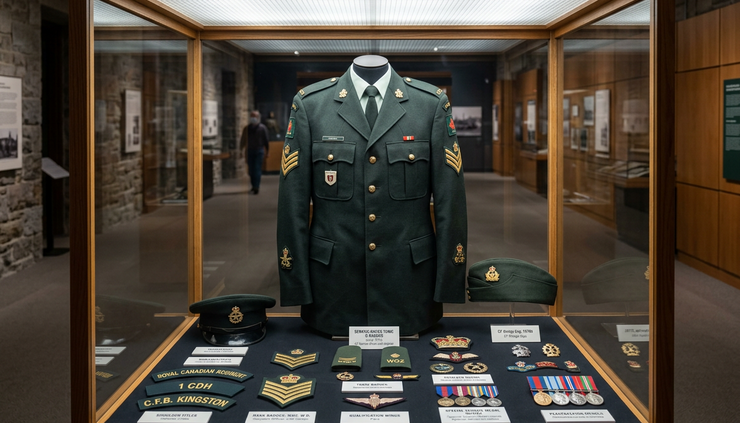
After unification, Canada introduced a common service dress, best remembered as the rifle green Canadian Forces uniform. This was one of the most visible symbols of the new system. Instead of three separate daily dress identities, personnel from sea, land, and air environments could appear in the same basic colour and cut.
For insignia, that meant a cleaner and more standardized appearance. Cap badges, rank badges, shoulder titles, and branch devices had to fit the new uniform concept.
The new look emphasized:
The Canadian Forces as a single institution
The maple leaf as a national marker
Common rank display across environments
Branch and command identity rather than the old service divide
Simpler supply and clothing administration
This created a sharp visual break with the pre-1968 military. A sailor, soldier, and air person might still do very different jobs, but their uniforms now communicated a shared service first.
Cap badges became a major point of identity
Cap badges carried some of the strongest emotions during unification. They sit at the centre of military identity because they are worn close to the face and often represent a regiment, corps, service, or branch.
In the army, cap badges had long been deeply personal. Infantry regiments, armoured regiments, artillery, engineers, signals, logistics, medical, and other groups all had distinctive designs. Many included crowns, maple leaves, animals, mottoes, scrolls, and symbols tied to battle honours or regional history.
The navy and air force also had powerful badge traditions. Naval insignia used anchors, crowns, rope, and maritime devices. Air force insignia drew on wings, eagles, and the RCAF’s blue-grey visual culture.
Unification did not simply erase every older badge at once, but it did change the system around them. Many personnel came to wear badges that reflected branch, command, or Canadian Forces identity rather than the pre-unification services as independent institutions.
For collectors, this is one reason the period is tricky. The same person’s career might include:
A pre-unification service badge
A transitional badge
A Canadian Forces branch badge
Later badges reflecting revived naval, army, or air identities
A uniform group from the late 1960s or 1970s may look plain compared with earlier regimental dress, but that plainness is part of the story. It reflects a deliberate attempt to build one Canadian military image.

Rank insignia was standardized for one force
Rank insignia had to be readable across the unified force. That goal sounds simple, but it was complicated by the fact that the navy, army, and air force did not all display rank in the same way before unification.
The navy traditionally used sleeve stripes, including the well-known executive curl in earlier naval practice. Army officers used crowns, stars, and other badges depending on rank and period. The air force had its own rank structure and insignia traditions derived from Royal Air Force patterns.
Unification pushed toward a common rank system and more consistent visual language. The aim was that a person from any part of the Canadian Forces could quickly recognize another member’s rank.
This affected several types of insignia:
Sleeve rank
Rank placement and form changed as common dress replaced older service uniforms.
Shoulder rank
Slip-ons and shoulder boards became important on many orders of dress.
Metal rank badges
Rank devices had to match the new uniform and common identity.
Non-commissioned rank insignia
Chevrons, crowns, and appointment badges also had to fit the unified system.
These changes were not only cosmetic. They shaped daily military life. Rank recognition affects saluting, command relationships, discipline, and routine interaction. A unified force needed a rank display that worked in mess halls, ships, air stations, training schools, and field units.
The emotional side was just as real. To some members, the new rank insignia felt modern and Canadian. To others, it stripped away familiar naval, army, or air force character. Both reactions help explain why insignia from this period still attracts attention.
Branch badges replaced many older corps identities
Unification also reorganized military occupations into branches. Instead of relying only on older corps and service distinctions, the Canadian Forces used branch identity to group people by function.
Branches covered broad fields such as operations, logistics, communications, medical services, engineering, and other specialist areas. Their badges helped show what a member did inside the unified force.
This created a new layer of insignia. A badge might no longer say “this person belongs to the old army corps” in the traditional sense. It might say “this person belongs to a Canadian Forces branch that serves across the whole military.”
That shift was especially important for support trades. A technician, clerk, driver, cook, medic, or communications specialist might serve with army, navy, or air units, but the branch system tied them to a wider professional identity.
The branch badge system made sense from an administrative point of view. It supported a single personnel structure and reduced duplication. Yet it also made some older identities less visible on everyday dress.
For historians, branch badges are one of the clearest signs that an item belongs to the unification era. They show the effort to make the military look and function as one organization.
The maple leaf became even more central
The maple leaf had appeared in Canadian military badges long before unification. It was common in militia badges, regimental devices, cap badges, collar badges, and national symbols. After the adoption of the national flag in 1965, the maple leaf gained even stronger public meaning.
Unification made the maple leaf even more useful as a military symbol. It was national, bilingual in effect, and not tied to only one service. It could speak for Canada without relying on naval, army, or air force tradition alone.
During this period, insignia often leaned into Canadian symbols such as:
Maple leaves
The Crown
“Canada” shoulder titles or identifiers
Bilingual or nationally neutral design choices
Common Canadian Forces devices
The Crown remained important because Canada’s military served under the Crown. The maple leaf gave the insignia a distinct national character. Together, they allowed designers to preserve continuity while building a more Canadian visual identity.
This is why unification-era badges can look spare but meaningful. They often avoid older service-specific imagery and rely instead on symbols that could work across the whole force.

Naval identity was reduced but not forgotten
The Royal Canadian Navy lost a great deal of visual distinctiveness under unification. The separate naval uniform and many traditional naval details were replaced or limited in daily use. For personnel with strong attachment to naval dress, this was a major cultural change.
Naval identity did continue in other ways. Ships, sea service, naval customs, and maritime command structures still existed. A person could still belong to the sea environment in practice, even if the uniform no longer looked as strongly naval as before.
Some naval symbols survived in badges connected to maritime roles. Anchors, ropes, crowns, and naval devices continued to appear where the job or branch called for them. Yet the broader impression changed. The sailor on shore no longer looked as clearly like a member of a separate navy in the old sense.
This tension remained for decades. Later restorations of naval dress and symbols show how strong that identity remained. The return of traditional features, including naval rank style and the executive curl in the modern era, reflects a wider move to recover environmental heritage while keeping a unified armed forces structure.
Army identity survived most clearly through regiments
The army entered unification with a complex badge culture. Regiments and corps had their own identities, and many were tied to local communities, wartime service, and long-standing customs.
Unification reduced the prominence of some old army corps distinctions in regular daily dress, but regimental identity proved hard to erase. Infantry, armoured, artillery, and other units continued to value their badges, customs, and ceremonial dress.
This is why army-related insignia from the period may show two forces at work:
The common Canadian Forces system
The continuing pull of regiment and corps tradition
A field uniform might be practical and standardized. A dress occasion might bring back more distinctive symbols. A unit badge might survive in one context while branch badges appeared in another.
For collectors, army items from the unification period require close attention. A badge alone may not tell the whole story. The backing, uniform type, rank insignia, shoulder titles, and provenance all help place it correctly.
Air force identity was quieted, then later revived
The Royal Canadian Air Force had a strong visual identity before unification. Its blue uniform, wings, rank forms, and eagle imagery marked it as part of a wider Commonwealth air force tradition.
The unified green uniform muted that identity. Air personnel still flew, maintained aircraft, controlled air operations, and served in air commands, but the daily uniform no longer showed the same immediate RCAF character.
Flying badges and specialist aircrew insignia remained important because they represented qualifications. Wings are not merely decorative. They show training, role, and professional achievement. These badges helped preserve air identity even when the wider uniform system was common.
Over time, air force identity returned more strongly. Canada restored the historic Royal Canadian Air Force name in 2011, along with the Royal Canadian Navy and Canadian Army names. Later changes brought back more traditional rank and uniform features. This modern revival makes the unification period easier to understand as a middle chapter rather than a clean break from the past.
How to identify unification-era insignia
Dating Canadian insignia from this era often means looking at the whole item, not just one badge. Many designs stayed in use across more than one period, and surplus or older badges could remain in drawers, kit bags, or ceremonial contexts.
A careful review should include these clues.
Feature | What to look for | Why it helps |
Uniform colour | Rifle green service dress | Strong sign of the unified Canadian Forces period |
Badge theme | Branch or common-force symbols | May point to post-1968 identity |
Rank style | Common Canadian Forces rank display | Shows the move away from older service-specific systems |
Shoulder titles | “Canada” identifiers or unified patterns | Helps place the uniform in the national system |
Construction | Metal, cloth, bullion, or staybrite finish | Gives clues, though not always exact dates |
Provenance | Name, service history, unit, or photographs | Often the best evidence |
Collectors should be cautious with exact dating. Badges could be issued, retained, replaced, or privately acquired at different times. A veteran might keep older insignia long after official dress changed. A ceremonial uniform might show traditions not seen in daily wear.
The safest method is to compare several details together. A green service dress jacket with Canadian Forces branch insignia, common rank features, and period photographs offers stronger evidence than a loose badge in isolation.
Why the changes were controversial
Unification was meant to make Canada’s military more efficient and more clearly national. Supporters saw common insignia and uniforms as practical. They reduced duplication, simplified supply, and helped present one force to the public.
Many service members saw something else. They felt that badges and uniforms carried memory. A naval curl, an air force blue tunic, or a regimental badge could represent years of service and generations of tradition. When those symbols were reduced or removed, the change felt personal.
Both views had force. A modern military needs clear administration and shared identity. It also needs loyalty, pride, and continuity. Badges sit exactly where those needs meet.
That is why unification-era insignia remains so interesting. It shows Canada trying to answer a difficult question: how can one military preserve three powerful service cultures?
The legacy of unification insignia
The unification period did not end Canadian military tradition. It rearranged it. Some symbols disappeared from daily view. Some survived in branch, trade, or ceremonial use. Others came back later as Canada restored more visible naval, army, and air force identities.
That makes the badges and insignia of the period valuable historical evidence. They show policy in metal and cloth. They reveal how a national institution tried to modernize while carrying older loyalties with it.
A cap badge from this time is not just a collectible. A rank slip-on is not just a uniform part. Together, they tell the story of a military that tried to look like one force, even while its members still served at sea, on land, and in the air with distinct traditions behind them.
The best way to read Canadian unification insignia is to hold both ideas at once. The badges speak of change, but they also show continuity. That tension is what makes them worth studying.


Comments