

Canadian Cadet Badges: A Collector’s Field Guide

A cadet badge is rarely just a small piece of metal or cloth. It may mark a young person’s first connection with service, a local corps identity, a specialist qualification, or an institutional change within the Canadian Cadet Organisations. For collectors, Canadian cadet badges occupy a distinct and rewarding field: familiar enough to sit beside Canadian Army, Royal Canadian Air Force and Royal Canadian Navy material, yet varied enough to require their own reference knowledge.
The strongest collections are built by reading each badge as evidence. Its title, crown, construction, fastening, maker mark and wear pattern can each help place it within the long record of Canadian youth training, citizenship and service tradition.
The Cadet framework behind the insignia
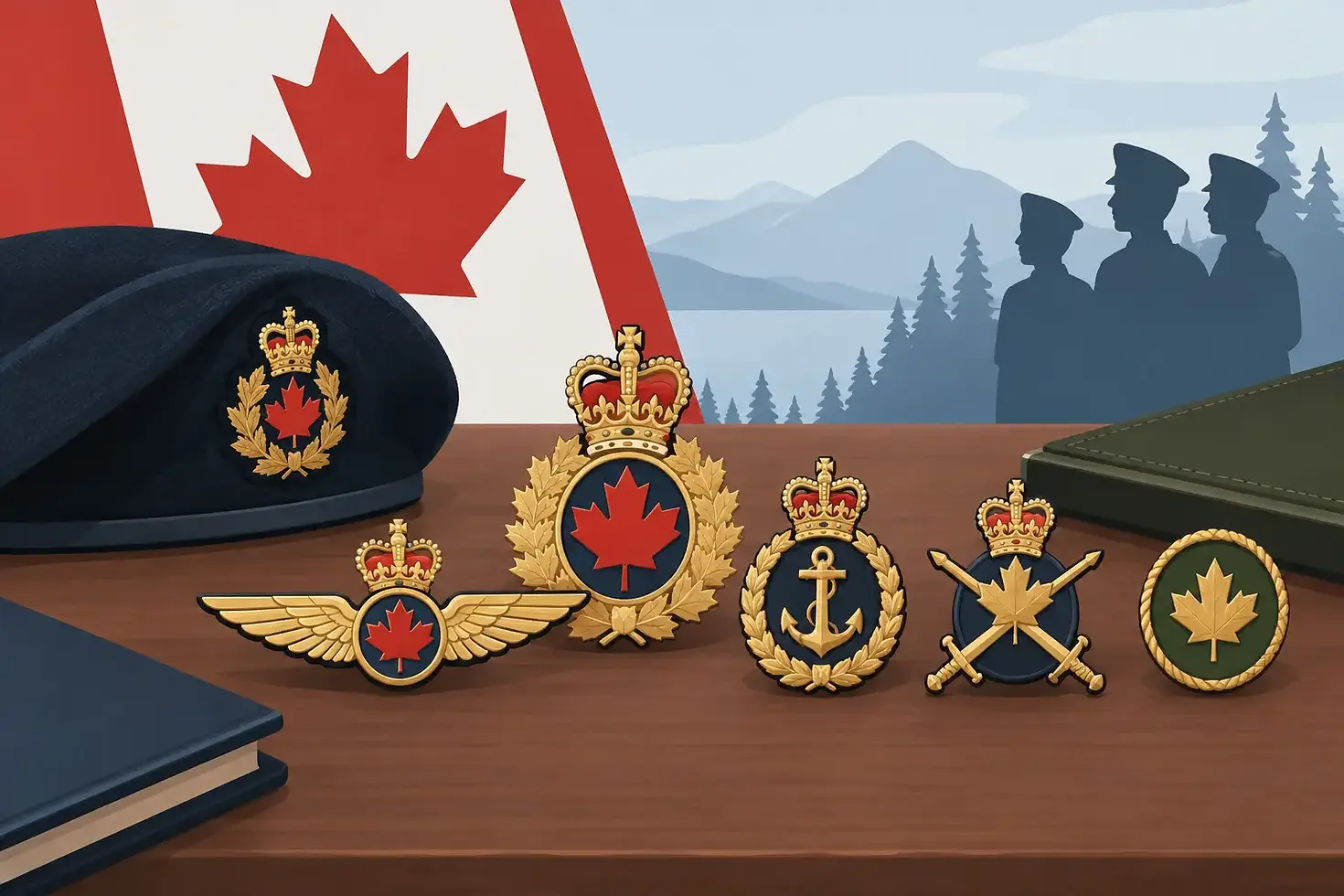
Canada’s cadet movement has deep roots in school, community and militia traditions. Over time, Sea Cadets, Army Cadets and Air Cadets developed separate visual identities, drawing deliberately upon the heraldry, uniforms and terminology of their associated services. That connection is central to identification. An anchor, fouled or plain, will direct the collector towards naval cadet material; crossed rifles, maple leaves and regimental devices commonly appear in Army Cadet insignia; wings, eagles and Air Force pattern crowns point towards Air Cadet use.
The material should not, however, be treated simply as miniature regular-force insignia. Cadet badges were issued through national, regional and local channels, and individual corps could retain especially distinctive identities. Some wore badges modelled on affiliated Canadian Army regiments; others used corps-specific titles, shoulder flashes or locally authorised devices. The result is a field with substantial regional variation and many short-lived patterns.
Changes in royal cyphers and crowns are particularly useful dating tools. A badge bearing a Tudor Crown generally belongs to the earlier twentieth-century period, while a St Edward’s Crown indicates a later issue. This is a guide rather than an absolute rule, especially where older stock remained in use, but it is a sound starting point.
Main types of Canadian cadet badges
A well-organised collection begins by separating badges according to function. Mixing cap badges, collar badges, qualification insignia and cloth formation signs in one undifferentiated group makes later identification far harder.
Cap and collar badges
Cap badges are the principal metal insignia encountered by most collectors. They range from general service-style patterns to badges associated with named corps, affiliated units or cadet branches. Earlier examples may be die-struck brass, gilt brass, white metal or bi-metal construction. Later pieces can appear in anodised aluminium, plated base metal or lightweight modern alloys.
Collar badges are often more difficult to find as matched pairs. They may repeat the cap-badge design at reduced scale, use separate initials or symbols, or be supplied as a pair of opposing devices. A single collar badge should be described as such, not represented as a complete set. For the collector seeking uniform display quality, original paired collars with matching finish and fittings command understandable interest.
Shoulder titles and cloth flashes
Embroidered and woven insignia provide some of the clearest evidence of corps, branch and regional identity. Look for titles identifying Sea Cadets, Army Cadets or Air Cadets, as well as corps names, provincial designations and formation-level markings. Earlier embroidered examples may show hand-finished details, while later issues are often machine woven or merrowed.
Cloth badges deserve close inspection for backing, thread type and edge finish. A period badge may still be unused, but bright colours alone do not establish age. Conversely, moderate fading, removed stitching or service wear can support a credible uniform-used history. Condition affects value, though a scarce named corps flash may remain desirable even with honest wear.
Proficiency, rank and appointment insignia
Cadet programmes have long recognised achievement in training, trade-related skills, leadership and specialist appointments. Proficiency badges can include marksman, musician, first aid, sailing, aviation and other programme-related subjects, depending on the period. Rank chevrons and appointment badges are more common, but they document the internal structure of a corps and belong in a representative collection.
These badges are best collected with attention to chronology. A current-pattern badge should not be mounted beside a wartime or mid-century example without clear labelling. Design changes may be subtle: a revised crown, altered embroidery, a new title or a shift from embroidered to woven manufacture can mark an entirely different issue period.
How to date and identify an unfamiliar badge
An unfamiliar item should be examined methodically before any attribution is made. Start with the exact wording. Initials such as RCAC, RCSCC or RCACS may be decisive, but collectors should be alert to older nomenclature and to badges produced for cadet corps affiliated with a regiment rather than carrying an overt cadet title.
Then examine the reverse. Lug fittings usually suggest an earlier metal badge, though replacement lugs and repairs exist. Slider fittings, clutch posts, tangs and screw backs can each help narrow the likely era. Maker marks are equally valuable. A known Canadian manufacturer’s stamp may support period attribution, while an unmarked badge is not automatically suspect. Many legitimate issues, especially cloth insignia and some economy patterns, carry no maker identification.
Construction often tells the fuller story. Die-struck detail should be crisp but not artificially sharp. Original brass tends to develop a quiet, uneven patina; white metal may darken in recesses; old gilt can survive in protected areas beneath the crown or around lugs. Excessively uniform ageing, crude cast detail, porous metal and modern-looking fasteners should prompt caution.
Reference photographs are useful, but dimensions matter too. Measure height and width, note the style of crown, identify the metal, and record every reverse detail before comparing examples. Many collector errors arise because a similar badge is assumed to be identical. A different fastening or banner wording can indicate another corps, a different manufacturer or a later reproduction.
Originality, condition and provenance
Cadet material is sometimes undervalued because it was produced in quantity and used by youth organisations rather than regular service personnel. That view overlooks two realities. First, many badges were worn hard, discarded after a short period or never retained by the wearer. Secondly, named corps material and earlier issues can be genuinely scarce, especially when found with supporting uniform pieces, photographs or paperwork.
Originality should take precedence over cosmetic appeal. A cap badge with intact original lugs, light wear and an untouched surface is generally a better historical object than a heavily polished example made to look new. Cleaning can remove finish, flatten fine detail and erase the evidence that helps establish age. Cloth insignia should likewise be kept dry, away from direct sunlight, and stored so that folds do not permanently distort the embroidery.
Provenance need not be elaborate to be worthwhile. A handwritten label identifying a corps, town or former cadet can add useful context if retained with the item. Groupings are especially valuable: a cap badge with collars, shoulder titles, rank insignia and a named photograph provides a much stronger record than isolated components. The documents should be preserved even where the name cannot yet be verified.
Collectors should also distinguish historical issues from current insignia. There is no inherent objection to collecting modern cadet badges, particularly when building a complete series, but they should be described accurately and not offered as vintage material. Care is also appropriate around badges that might be mistaken for current authority or uniform identification. A collection is best presented as historical and educational material, with its service context respected.
Building a focused cadet collection
The broadest approach is to collect across Sea, Army and Air Cadet branches, tracing the evolution of their cap badges, titles and proficiency insignia. It gives an excellent overview, but it can become expansive quickly. A more focused collection might follow one local corps, one province, one affiliated regiment, or a defined period such as the Second World War through the unification era.
Affiliation collections can be especially satisfying. A collector of a Canadian regiment’s cap badges may add associated Army Cadet badges, collar devices, shoulder titles, photographs and manuals to show how regimental tradition was carried into cadet life. Similarly, naval collectors can place Sea Cadet insignia alongside naval reserve and Royal Canadian Navy material without confusing the separate organisations.
Record keeping pays dividends. For each piece, note the branch, corps or affiliation, material, dimensions, maker, fastening, acquisition source, condition and any known provenance. A simple catalogue prevents duplicates and makes patterns visible over time. It also gives future custodians a proper account of what the collection represents.
A well-chosen cadet badge carries both institutional history and personal possibility: the memory of a parade square, a local corps, a first uniform, and a tradition of service passed forward. Collect with patience, preserve the evidence that accompanies each piece, and let the smallest insignia retain its proper place in Canada’s wider military heritage.


Comments