

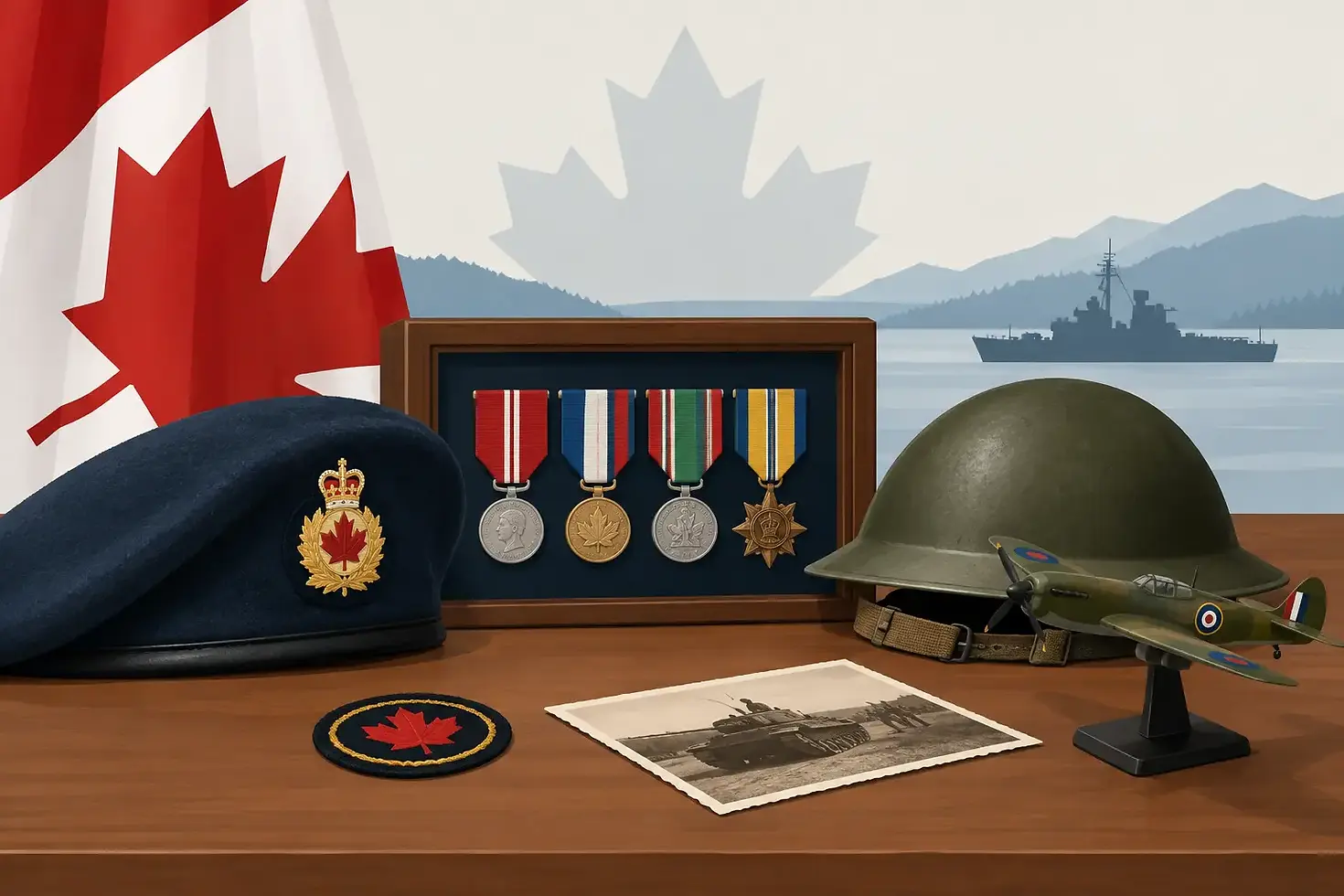
Canadian Military Collectibles Worth Collecting

A Canadian cap badge is rarely just a piece of metal. Its maker mark, fastening arrangement, regiment, crown pattern and period of issue can place it within a particular chapter of service. That is the lasting appeal of Canadian military collectibles: the best pieces preserve evidence of the men and women, units and institutions that stood on guard for Canada.
For the serious collector, the aim is not simply to accumulate medals, badges or uniforms. It is to build a collection with historical coherence. A Second World War Royal Canadian Air Force observer's wing, a Canadian Army formation patch, a Royal Canadian Navy trade badge or a named medal group each asks different questions about originality, condition and context. Knowing which questions to ask before purchase is what gives a collection depth.
Start Canadian Military Collectibles With a Clear Scope
Canadian militaria is broad enough to reward specialisation. A collector may concentrate on the Canadian Expeditionary Force of the Great War, interwar militia insignia, Second World War corps badges, Cold War-era RCAF uniforms, modern Canadian Armed Forces shoulder titles or cadet material. Others build around a particular regiment, province, trade or service branch.
A narrow collecting remit is not a limitation. It makes research more productive and helps distinguish a meaningful variation from a duplicate. Someone studying the Royal Canadian Regiment, for example, may compare officer and other-rank cap badges, collar badges, shoulder titles, buttons, sweetheart jewellery and photographs. Over time, those related objects can show changes in manufacture, dress regulations and unit identity.
Service-based collecting is equally useful. Canadian Army material is often organised by era, regiment and corps. RCAF collecting may centre on wings, rank insignia, cloth badges, buttons, flying clothing, log books and squadron ephemera. RCN collections can develop around tallys, trade badges, cap tallies, uniforms and ship-related souvenirs. Each route gives the collector a practical catalogue structure without losing sight of the personnel behind the objects.
Read the Object Before You Buy It
Originality is the foundation of any historical collection, but it is not a single test. Period pieces were made by different contractors, altered during service, repaired by families and worn in hard conditions. A badge that is not pristine is not automatically suspect. Conversely, a sharply finished example with an implausibly bright surface can warrant close inspection.
Insignia and badges
With cap badges, collar badges and shoulder titles, begin with construction. Look at the metal, die detail, lugs or sliders, attachment method, finish and reverse. Compare these features against known period examples, rather than relying solely on the design seen from the front. A contemporary badge may have a maker's mark, but the absence of one does not by itself prove a badge is later. Makers, contracts and manufacturing practices varied.
Cloth insignia needs the same discipline. Examine the weave, embroidery, backing, edge treatment and signs of wear. Wartime production can be economical and irregular; a perfectly uniform modern reproduction may look more convincing in a photograph than it does in hand. Colour should be considered with care, as sunlight, laundering and storage all affect wool, cotton and thread.
Medals and ribbon groups
Medals deserve a provenance-minded approach. Check official naming, suspension, impressed or engraved details where applicable, ribbon width and age, mounting style and the relationship between medals in a group. A court-mounted group may have been prepared for wear long after the medals were issued, which does not make it less legitimate. It does mean the mounting should be described separately from the entitlement.
Research the recipient where a name is present. Service papers, unit histories, casualty records, published rolls and local newspapers can turn a campaign medal into a documented service story. Be cautious with groups that claim dramatic provenance without supporting evidence. The more exceptional the claim, the stronger the documentation should be.
Condition Is Part of the History
Collectors often debate whether an item should be cleaned, repaired or left untouched. The answer depends on the object and on what intervention would remove. In most cases, sympathetic preservation is preferable to restoration intended to make an object look new.
Natural patina on brass or bronze, honest wear to a cap badge, a period name label in a tunic and age to a ribbon can all contribute to an item's evidential value. Harsh polishing may erase detail and reduce collector appeal. Equally, active corrosion, mould or insect damage should not be ignored. Stabilising deterioration is responsible collecting, particularly for wool uniforms, leather webbing, paper documents and photographs.
Store metal insignia in a dry, stable environment and keep it away from unsuitable plastics, adhesive tapes and abrasive polishes. Textile material benefits from clean, acid-free support and protection from direct light. Paper ephemera should be handled with clean, dry hands and housed so that folds, damp and sunlight do not continue their damage. Good storage does not make an item more original, but it preserves the evidence that makes originality easier to judge.
Provenance Gives Canadian Militaria Its Voice
A loose badge can still be a desirable period example. Yet a badge retained with photographs, correspondence, discharge papers or a named uniform becomes something more complete. Provenance connects an object to service rather than merely to manufacture.
Family groups require particular sensitivity. Names, handwritten notes and even apparently ordinary envelopes may provide the links needed to identify a soldier, sailor, airman, nurse or public-safety officer. Keep those associations together whenever possible. Separating a named medal from its supporting paperwork may improve neither its historical value nor its long-term appeal.
Not every object will have a full history, and collectors should not invent one. Describe what is known, distinguish it from family tradition or seller attribution, and retain a record of where and when an item was acquired. A simple collection ledger noting measurements, markings, condition, price, source and research findings becomes increasingly valuable as the collection grows.
Build Across Service and Public-Service Heritage
Canadian collecting naturally reaches beyond combatant branches. Police, fire and EMS insignia document public service at municipal, provincial and federal levels, often with the same regional specificity that attracts collectors to military shoulder flashes. Aviation and naval items add further specialist fields, from squadron badges and flight-related ephemera to naval trade insignia and shipboard material.
This wider view should remain disciplined. A collector of Canadian Army badges may add a local police cap badge because it belonged to the same individual or town, while another may keep military and public-service collections separate. Neither approach is wrong. The important point is to record the connection rather than allowing a collection to become an unexamined assortment.
Commonwealth material can also provide essential context. Canadian forces shared traditions, equipment patterns and honours systems with Britain and other Commonwealth nations, but similarities should never be treated as proof of Canadian issue. A crown, title or fastening that looks familiar may belong to a different country, era or organisation. Precise identification protects both the collection and the historical record.
Buy for Research Value, Not Just Rarity
Rarity matters, but it is only one part of desirability. An uncommon badge with uncertain origin may be less satisfying than a well-documented, ordinary issue tied to a named veteran. Likewise, condition premiums are sensible when the object is genuinely scarce, but a collector should not overlook honest service wear in pursuit of perfection.
Before acquiring a piece, consider whether it advances the collection's story. Does it fill a dated gap? Is it a variation you can identify confidently? Does it retain original components? Can its unit, maker or recipient be researched? These questions slow the impulse purchase and strengthen the collection over years rather than weeks.
Canadian military collectibles are custodial objects. Whether the item is a wartime cap badge, an RCAF wing, a naval tally or a carefully preserved ribbon bar, its significance lies in the service it represents. Choose pieces with clear purpose, preserve their accompanying evidence and leave each one better documented for the collector who studies it next.


Comments