

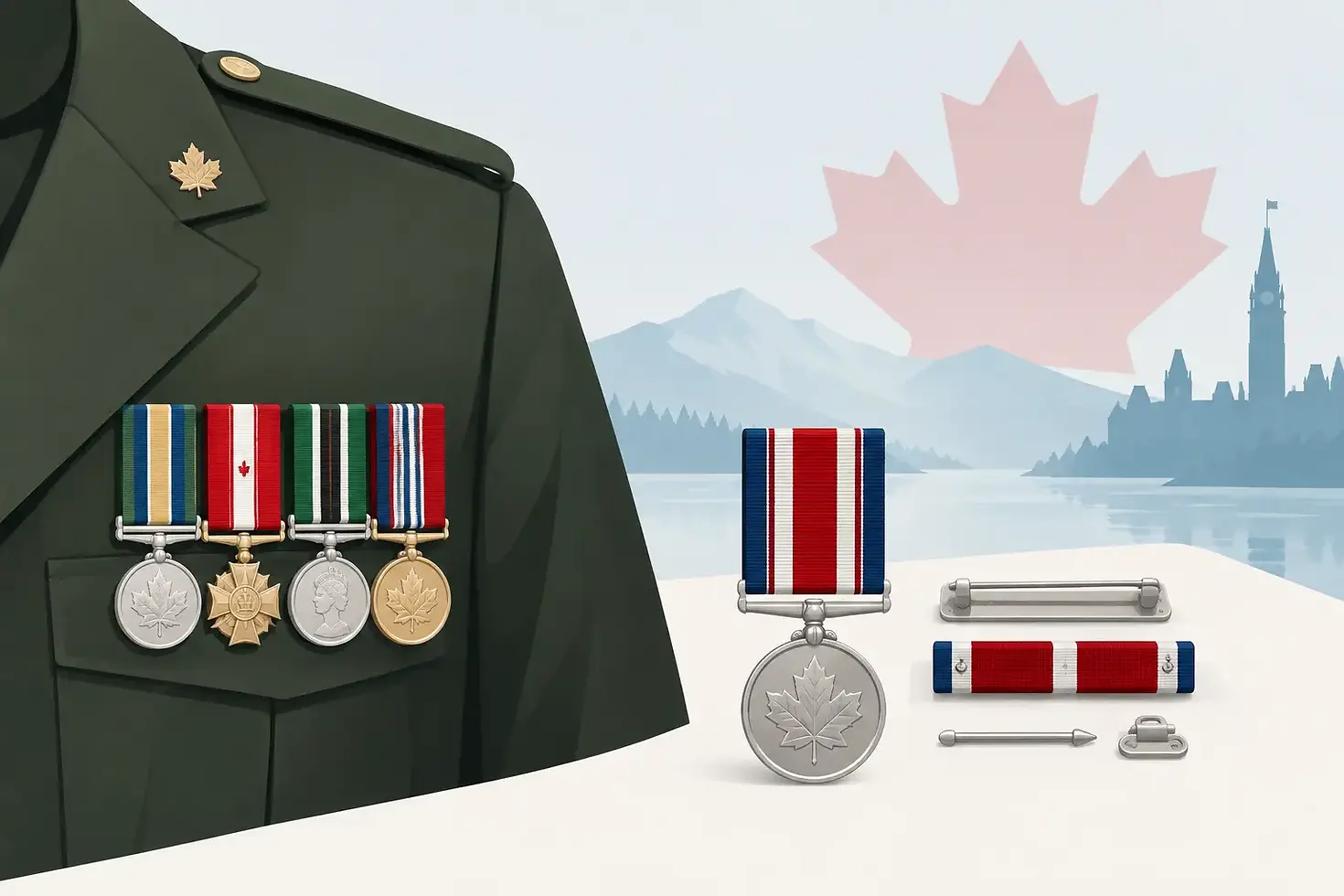
Canadian Military Medal Mounting Explained

A medal group is not merely an arrangement of metal, ribbon, and backing. It is a record of service presented in the sequence authorized to the recipient. Proper Canadian military medal mounting protects that record, whether the group is being prepared for wear, preserved within a family, or cataloged as part of a serious collection.
For collectors, the quality of a mount can affect both display value and historical interpretation. For veterans and families, it is a matter of respect. A neatly mounted group should sit correctly, show each award clearly, and retain the details that connect it to the individual who earned it.
What Canadian Military Medal Mounting Means
Canadian medals are generally encountered in one of two mounting styles: swing mounting and court mounting. Both may be appropriate, but they serve different purposes and produce a visibly different result.
Swing-mounted medals hang independently from their ribbons. They move when worn and retain the traditional appearance familiar from earlier Canadian and Commonwealth medal groups. This style allows the full reverse of each medal to be seen when handled, which can be useful to collectors examining naming, maker marks, or official engraving.
Court-mounted medals are secured to a rigid backing. The ribbons are folded and fixed over a backing board, while the medals are attached at the lower edge so they remain close together. The finished group lies flatter against the uniform, produces less movement, and is often preferred for contemporary formal wear. A court mount may use a narrow visible strip of ribbon below the medals, with the remainder carefully folded behind the backing.
Neither style automatically makes a group more authentic or more desirable. A period swing mount may be exactly right for a Second World War or Korea-era group. A later court mount may reflect how a veteran continued to wear the awards at reunions, ceremonial events, or branch functions. The question is whether the mounting is correct to the group, its era, and its intended use.
Order of Wear Comes Before the Mount
The central rule in Canadian military medal mounting is that medals must appear in the authorized Canadian order of precedence. The order is not based on visual preference, campaign chronology, or the size of a medal. It is set by official direction and can change as new honors are instituted or precedence is revised.
A mount that is technically tidy but places awards in the wrong order is not correct. This is especially relevant in mixed groups containing Canadian honors alongside British, Commonwealth, United Nations, NATO, or foreign awards. Such combinations require care. Foreign awards may have distinct rules governing acceptance and wear, and their place within a Canadian group is not something to guess from an old photograph or an internet listing.
Collectors should also distinguish between an original, worn group and a modern remount. An original group with its ribbons faded by service use, perhaps mounted by a local military tailor decades ago, may carry strong historical value even if it does not meet a modern dress-standard finish. Replacing that work with bright new ribbon and a contemporary court mount can erase evidence of the medal group's history.
For a serving member preparing medals for uniform wear, the current Canadian Armed Forces dress instructions and the appropriate chain of command take precedence over collector convention. For family and display purposes, the goal is usually faithful preservation rather than creating a newly regulation-ready set.
Check the medals, ribbons, and devices individually
Before any mounting work begins, identify every component. Confirm that each medal is the proper issue, that the ribbon has not been substituted, and that any clasp, bar, rosette, oak leaf, numeral, or other device is present and positioned correctly. Small errors matter. A missing clasp may represent a specific theatre or period of qualifying service; an incorrect ribbon can turn a coherent group into a misleading one.
This inspection is also the time to record details that may later be obscured by a court mount. Photograph obverses and reverses, note naming and serial information, identify ribbon makers where possible, and retain detached original ribbon fragments, pin assemblies, and backing materials. Those modest remnants can help establish period provenance.
Choosing Swing or Court Mounting
The best style depends on the purpose of the medals and the character of the group. For active ceremonial wear, court mounting is often practical because it keeps medals aligned and reduces clatter and wear. For a collector preserving a named First or Second World War group, retaining an existing swing mount can be the more historically sound choice.
Court mounting has trade-offs. It creates a clean presentation and protects ribbons from some handling, but portions of the ribbon and reverse sides of the medals are less accessible. It may also require ribbon replacement if the originals are fragile, stained, shortened, or mismatched. That is acceptable for a wearable duplicate set, but it deserves more consideration when the original ribbons are period materials.
Swing mounting preserves the traditional hang of each award and permits closer inspection. On the other hand, medals can strike one another, ribbons may twist, and a group can sit unevenly if suspension lengths are inconsistent. A well-made swing mount requires as much attention to spacing and alignment as a court mount.
Where an original group has genuine historical interest, consider a conservation-minded approach: retain the original mount intact, document it, and create a separate mounted set for wear or display if needed. Original named medals should not be drilled, polished aggressively, or altered simply to fit a new backing arrangement.
Materials and Workmanship to Look For
A proper medal mount should be secure without placing unnecessary strain on the medals, ribbon suspension bars, or pins. Ribbons should be cleanly cut, evenly aligned, and free of visible adhesive residue. Medal faces should sit at a consistent height, and the group should hang or lie straight when supported from the brooch bar.
For court-mounted groups, inspect the ribbon folds closely. They should be symmetrical and should not conceal portions of neighboring ribbons in a careless manner. The backing should be firm enough to hold its shape, while the brooch fitting must be substantial enough for the completed weight of the group. Thin wire, unstable glue, and loosely stitched medal loops are warning signs.
Collectors also value period construction. British and Canadian-mounted groups from the mid-20th century may show hand-sewn ribbon work, tailor labels, wool or buckram backing, and fittings that differ from modern commercial mountings. These details are not defects. They can help date an assembly and may support an attribution when considered alongside naming, service papers, photographs, or uniform provenance.
Do not use abrasive metal polish to make medals look new. Original toning, light handling marks, and age-consistent patina are often preferable to an unnaturally bright surface. Clean only when necessary and with methods suited to the medal's composition. Silver, gilt, bronze, and plated pieces react differently, while painted or enameled elements require particular restraint.
Miniatures, Ribbon Bars, and Display Groups
Miniature medals follow the same essential order of wear as full-size awards, but their mounting presents separate challenges. Because miniatures are small, poorly matched ribbon widths or uneven spacing become obvious quickly. A miniature group intended for mess dress or formal evening wear should be mounted with the same attention given to full-size medals.
Ribbon bars are not substitutes for medals in a collector display, but they can add useful context. A correctly assembled ribbon bar may show the recipient's award sequence at a glance, particularly when paired with photographs or service documents. It should be treated as its own artifact, however. Do not assume a loose ribbon bar and a medal group belonged together without supporting evidence.
For framed displays, avoid permanently fixing the medals with glue. Use archival-quality supports that allow the group to be removed for examination. Keep direct sunlight away from ribbons, which are especially vulnerable to fading, and avoid damp storage areas that can stain fabric and corrode metal fittings.
When Remounting Is the Right Decision
Remounting is justified when a group is unstable, dangerously deteriorated, incorrectly assembled, or intended for authorized wear and no longer meets the necessary standard. It can also be appropriate where medals have been reunited after years of being stored loose, provided the order and entitlement are documented.
The decision should be conservative. A named campaign pair with original ribbons and a period tailor-made suspension should rarely be treated like a set of replacement medals. Conversely, a modern duplicate set used for parade, remembrance observances, or family ceremonial occasions may benefit greatly from a durable new court mount.
Before sending any group for work, photograph it from front and back, list every medal and device, and state clearly whether original ribbons and fittings must be retained. If a medal is named, record that naming in full. Good documentation protects the owner and preserves the historical trail for the next custodian.
A correctly mounted Canadian group honors more than dress regulations. It preserves the visible order of a person's service, from national honors to campaign medals and long-service recognition. Handle it with the same care you would give a named cap badge, an RCAF wing, or a unit shoulder title: as evidence that someone answered the call to serve.


Comments