

Lower Canada Volunteer Militia History Battles Badges and Canadian Identity
A militia button dug from an old farm field can feel tiny in your hand, but it carries a lot of weight. It points to a time when defence in Lower Canada wasn’t just the work of professional soldiers. It was tied to parishes, town streets, river crossings, family names, local politics, and the uneasy question of what kind of country would grow along the St. Lawrence.
The story of the Lower Canada Volunteer Militia sits at the meeting point of three worlds: British imperial defence, French Canadian community life, and the early roots of Canadian military tradition. It’s also a rich subject for collectors, because badges and insignia from this world can tell us where a person served, what status they held, and how local identity blended with loyalty to the Crown.

The militia grew from local duty and imperial worry
Lower Canada came into being in 1791, after Britain divided the old Province of Quebec into Upper Canada and Lower Canada. Lower Canada covered much of what is now southern Quebec, with Montréal and Québec City as key centres.
Defence was a serious concern from the start. The colony sat beside the United States, a young republic that had already fought Britain once. British regular troops guarded forts and major routes, but they couldn’t be everywhere. That’s where the militia came in.
There were two broad forms of militia service.
The first was the sedentary militia, made up of local men who could be called out for service. This was not “sedentary” in the modern sense of sitting around. It meant the men were tied to their home district and expected to defend it when ordered.
The second was made up of more active bodies, including volunteer and embodied units. These men trained more often, wore more formal kit when available, and could serve in campaigns away from home. In wartime, the line between local obligation and volunteer enthusiasm could blur.
Lower Canada’s militia system also reflected the society around it. French-speaking Canadian farmers, English-speaking merchants, seigneurs, clerks, artisans, and Indigenous allies all played roles in the defence of the colony. Service could bring pride, pressure, or suspicion, depending on the moment and the community.
The War of 1812 gave the militia its defining stage
The War of 1812 turned militia service from paper obligation into lived experience. The United States declared war on Britain in June 1812, and British North America suddenly had to defend a long border with limited regular troops.
In Lower Canada, the threat focused on the routes leading toward Montréal. If an American army captured Montréal, it could split Upper Canada from the Atlantic supply line. That made the Richelieu River, the Châteauguay River, and the roads south of Montréal extremely important.
Charles-Michel de Salaberry and the Canadian Voltigeurs
The most famous Lower Canadian militia figure from the war was Charles-Michel de Salaberry. Born into a French Canadian military family, he had served in the British Army before raising the Canadian Voltigeurs in 1812.
The Voltigeurs were not just a regular local company with fancy uniforms. They were a light infantry unit, trained for scouting, skirmishing, and fighting in wooded country. De Salaberry understood the terrain, the people, and the value of confidence. His leadership helped prove that locally raised troops could do serious work.
His reputation rests above all on the Battle of Châteauguay, fought on 26 October 1813.
The Battle of Châteauguay
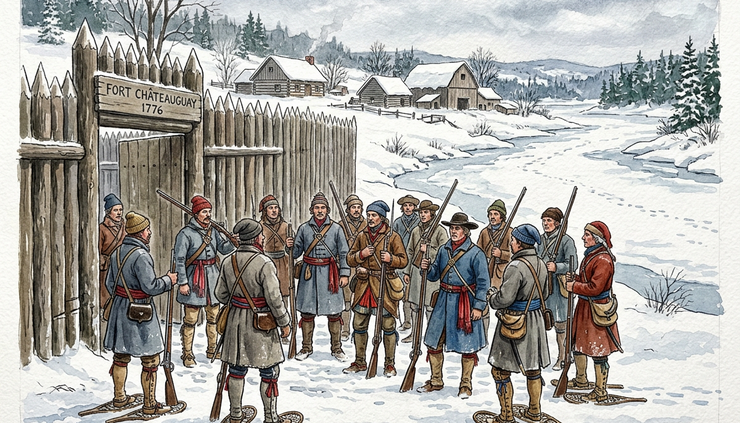
At Châteauguay, de Salaberry’s force helped block a larger American army advancing toward Montréal. His troops used felled trees, hidden positions, bugle calls, and the thick woods to make their numbers seem greater than they were.
The fighting involved Canadian Voltigeurs, local militia, and Indigenous warriors, including men from communities such as Kahnawà:ke. The result was a Canadian defensive success that became one of the best-known militia actions of the war.
Châteauguay mattered because it showed that local forces could defend local ground. It also became a powerful memory in French Canadian military history. De Salaberry emerged as a hero, and later generations used the battle as proof that French Canadians had helped defend the colony, not just lived under British rule.
Lacolle Mills and the border war
Another important action came at Lacolle Mills in March 1814. British and Canadian forces defended a stone mill near the border against an American attack. The battle was smaller than Châteauguay, but it had the same basic importance: it protected the approaches to Montréal and showed how geography shaped the war.
Fighting in Lower Canada rarely looked like the grand battle paintings of Europe. It often centred on roads, blockhouses, river crossings, mills, and village approaches. That makes militia history especially local. A landmark that looks ordinary today may have once mattered a great deal.
Battle or action | Date | Why it mattered |
Châteauguay | 26 October 1813 | Helped stop an American advance toward Montréal |
Crysler’s Farm | 11 November 1813 | Part of the wider defence of the St. Lawrence route |
Lacolle Mills | 30 March 1814 | Protected a key border approach into Lower Canada |
Badges and insignia tell the story in metal and cloth
For collectors, this is where the story becomes wonderfully tangible. Lower Canadian militia items can be difficult to identify, but that’s part of the appeal.
Uniforms were not always consistent, especially in the early years. Some men wore civilian clothing with military gear added. Others had coats, caps, belts, or buttons that marked them as part of a specific corps. Officers often had better-quality materials than the rank and file.
Common pieces connected to Lower Canada militia service may include:
Buttons
These might show a crown, royal cipher, unit number, or local wording. Buttons are often the most found and most studied items.
Cap plates
These were worn on headgear and could include a crown, bugle horn, unit title, or other military device.
Belt plates
These larger metal fittings sat on belts and often carried more detailed symbols.
Gorgets
These crescent-shaped officer pieces were worn at the throat. By the early 19th century, they were mostly symbolic, but they still marked authority.
Shoulder belt badges and devices
These helped identify a soldier’s unit or role, especially in more formally dressed companies.
The designs often used British symbols, such as crowns and royal initials, but local meaning crept in. Over time, Canadian symbols like the beaver and maple leaf became more common in military dress. This matters because insignia helped turn service into identity. A badge didn’t just say “I serve.” It said “I serve here, with these people, under this authority.”

The Rebellions of 1837 and 1838 changed the meaning of militia service
After the War of 1812, Lower Canada did not become calm and settled. Political tensions grew through the 1820s and 1830s. Many French Canadian reformers wanted more control over government and public money. British officials and local loyalists feared disorder and rebellion.
Those tensions erupted in the Rebellions of 1837 and 1838.
This period is more complicated than the War of 1812 because the militia was not simply defending the colony from an outside invader. It was part of an internal conflict. Loyal volunteer militia units supported the government, while Patriote forces fought against colonial authority.
Notable figures stood on different sides:
Louis-Joseph Papineau led the Patriote political movement and became a symbol of reform and resistance.
Wolfred Nelson was a Patriote leader involved in the fighting at Saint-Denis.
Sir John Colborne, a British commander, led government forces during the crisis.
Colonel George Wetherall commanded troops at Saint-Charles in 1837.
The militia’s role during these rebellions influenced local memory in very different ways. In some communities, volunteer service represented loyalty and order. In others, it looked like repression. That split memory still matters when we talk about Canadian identity, because Canada did not grow from one simple story. It grew from argument, compromise, loyalty, resistance, and the hard work of living together afterward.
Notable figures made the militia personal
Big forces shaped the militia, but people gave it character.
Charles-Michel de Salaberry remains the best-known Lower Canadian militia leader. His success at Châteauguay made him a symbol of French Canadian military skill within the British Empire.
Sir George Prevost, the governor-in-chief during much of the War of 1812, relied heavily on local defence. His approach was cautious, but in Lower Canada that caution helped preserve the colony’s key positions.
Lieutenant-Colonel Charles de Salaberry, as he is often styled, also mattered because he bridged cultures. He served the Crown, spoke to French Canadian loyalty, and commanded men who knew the land better than most imperial officers did.
Indigenous leaders and warriors also deserve attention. Their support in border fighting, including around Châteauguay, helped shape outcomes. They were not background figures. They had their own communities, goals, and political interests.
During the rebellion period, figures like Colborne, Wetherall, Papineau, and Nelson show how militia history connects to politics. Military service could defend a place, but it could also expose deep disagreements over who had power.
Local communities felt the militia in everyday life
The militia touched daily life in ways that don’t always show up in battle summaries.
A muster could pull men away from farms, shops, and river work. Families had to manage without them. Local leaders gained prestige through commissions. Parish networks helped spread orders and news. Taverns, church steps, and market squares became places where military updates mixed with gossip and rumour.
Militia service also shaped social status. An officer’s commission could confirm a family’s local influence. A uniform item, even a simple button or belt plate, could mark someone as part of public life. For younger men, service offered pay, adventure, or a sense of belonging. For others, it was a burden.
Communities also carried the memory of service. A family story about Châteauguay, a sword kept over a mantel, or a button found in a field could turn military history into local history. That’s one reason collectors often care so much about provenance, the known history of an object. A badge with a chain of ownership is more than metal. It becomes a small witness.
The militia helped shape Canadian identity
The Lower Canada militia helped shape Canadian identity in several ways.
First, it showed that local defence mattered. British regulars were important, but the colony could not rely on them alone. Local soldiers knew the roads, rivers, woods, and weather. That idea carried forward into later Canadian military tradition.
Second, it complicated ideas of loyalty. French Canadian militia service during the War of 1812 proved that loyalty to the Crown did not erase French language, Catholic faith, or local customs. People could defend their home while keeping a distinct identity.
Third, the rebellion years forced the colony to face political tension. The same militia tradition that defended Lower Canada from invasion also became part of a struggle over government and rights. That uncomfortable truth is part of the story.
By the time Canada became a country in 1867, the older Lower Canadian militia world had changed. Yet its influence remained. Citizen service, local pride, bilingual military memory, and the use of symbols like the crown, maple leaf, and beaver all carried echoes of earlier decades.
What collectors should look for
A militia badge or button linked to Lower Canada deserves careful study. Many items are hard to date, and later reproductions or commemorative pieces can look convincing at first glance.
A few practical checks help:
Look for clear unit markings, numbers, or wording.
Study the back of buttons, not just the front.
Compare construction methods with known period examples.
Treat perfect condition with caution.
Value written provenance when it exists.
Be careful with loose claims tied to famous battles.
The best pieces often raise questions before they answer them. That’s part of the fun. A collector might start with a small brass button and end up tracing a local regiment, a river campaign, or a family name from a parish roll.
FAQ
Was the Lower Canada Volunteer Militia the same as the Canadian Voltigeurs?
Not exactly. The Canadian Voltigeurs were a specific corps raised during the War of 1812. The wider militia included many local and volunteer units, along with men called out through the sedentary militia system.
What was the militia’s most famous battle?
The Battle of Châteauguay in 1813 is the best-known Lower Canadian militia action. Charles-Michel de Salaberry and his force helped stop an American advance toward Montréal.
Are Lower Canada militia badges rare?
Many are scarce, especially pieces with clear unit links and strong provenance. Buttons are more commonly encountered than complete insignia sets, but condition and identification vary a lot.
Did French Canadians serve in the militia?
Yes. French Canadians played a major role, especially in the War of 1812. Their service became an important part of French Canadian military memory.
Why do militia badges matter to Canadian history?
They make a broad story personal. A badge can connect military service to a town, a family, a language community, and a political moment.
A small object can open a big story
The Lower Canada militia was never just a footnote to British military history. It defended key routes, shaped local communities, produced figures like de Salaberry, and left behind badges and insignia that still speak to collectors today.
Its story is also a reminder that Canadian identity grew from layered loyalties. People defended their homes, argued over power, kept local traditions, and created symbols that blended empire, community, and place. That’s a lot for one old button to carry, but somehow, it does.


Comments