

Royal Canadian Air Force History From 1924 to Modern Missions and Aviation Milestones
On 1 April 1924, Canada gave its young air service a royal title and a national mission. The Royal Canadian Air Force began with modest resources, a handful of aircraft, and a sweeping set of duties across a vast country. A century later, it flies fighters on NORAD alert, moves troops and aid across continents, patrols oceans, rescues people in harsh weather, and supports Canadian and Allied operations around the world.
The story of the RCAF is not only a story of aircraft. It is also about geography, technology, war, peacekeeping, and the steady growth of Canadian air power. From bush flying and aerial mapping to Lancaster bombers, CF-18 fighters, long-range patrol aircraft, helicopters, and remotely piloted systems, the RCAF has changed with every era while keeping one constant role: defending Canada and serving abroad when called.

Canada builds an air force in the shadow of the First World War
Canada’s military aviation roots reach back before 1924. During the First World War, thousands of Canadians served as pilots, observers, mechanics, and instructors with British flying services such as the Royal Flying Corps and Royal Naval Air Service, later the Royal Air Force. Many became skilled flyers in a war that turned aircraft from fragile scouts into serious tools of combat.
After the war, Canada did not immediately build a large independent air arm. The country had other priorities, and aviation itself was still young. Yet government leaders understood that aircraft could solve problems that were uniquely Canadian. Canada needed to map remote regions, fight forest fires, support fisheries patrols, and move people and supplies across difficult terrain.
In 1919, the Air Board became Canada’s first body to manage civil and military aviation. The Canadian Air Force followed in 1920. Four years later, on 1 April 1924, the service became the Royal Canadian Air Force.
Early RCAF work looked very different from later images of jet fighters and strategic airlift. Crews flew open-cockpit and early enclosed aircraft over forests, lakes, coastlines, and Arctic approaches. They photographed terrain, checked ice conditions, helped with forestry, and supported government departments. These public-service tasks built practical flying skills in remote conditions, a Canadian specialty that would remain valuable in war and peace.
Early aircraft reflected the era. The RCAF flew types such as the Avro 504, de Havilland training aircraft, Vickers Vedettes for coastal and lake operations, and later aircraft suited to northern and bush flying. These machines were slow by modern standards, but they helped build the foundations of Canadian military aviation.
The Second World War turns the RCAF into a major air force
When Canada entered the Second World War in September 1939, the RCAF was still small. By 1945, it had become one of the largest Allied air forces. The war changed everything: organization, training, technology, aircraft, and Canada’s place in Allied air strategy.
The most famous Canadian contribution was the British Commonwealth Air Training Plan, often called the BCATP. Canada’s geography made it ideal for mass training. It had large open spaces, distance from enemy attack, and varied weather that prepared aircrew for harsh conditions. Airfields appeared across the country, from the Prairies to Central and Atlantic Canada. Trainees from Canada, Britain, Australia, New Zealand, and other Allied nations learned to fly, navigate, bomb, communicate, and maintain aircraft.
The BCATP became one of Canada’s greatest wartime achievements. It trained vast numbers of Allied aircrew and turned Canada into what U.S. President Franklin D. Roosevelt famously described as an “aerodrome of democracy.”
RCAF personnel served in many theatres and roles:
Fighter operations Canadian pilots flew aircraft such as the Hawker Hurricane and Supermarine Spitfire in the Battle of Britain, over northwest Europe, and in other campaigns.
Bomber operations Canadian squadrons flew Wellington, Halifax, and Lancaster bombers. No. 6 Group, Royal Canadian Air Force, served within RAF Bomber Command and became a distinct Canadian bomber formation.
Coastal patrols RCAF crews flew anti-submarine patrols over the North Atlantic, helping protect convoys that kept Britain supplied.
Transport and training Air transport, ferrying, maintenance, and instruction became essential parts of the Allied air effort.
The cost was heavy. Bomber Command operations were especially dangerous. Aircrew faced flak, night fighters, weather, mechanical failure, and long missions deep into enemy territory. Many did not return.

The Cold War brings jets, radar, and continental defence
After 1945, the RCAF shrank from its wartime peak, but it did not return to its prewar role. The Cold War created a new mission: defend North America from long-range bombers and later missiles, while supporting NATO overseas.
The jet age arrived quickly. Canada developed and operated some remarkable aircraft during this period. The Canadair Sabre became one of the finest fighters of its time and served with RCAF squadrons in Europe. The Avro Canada CF-100 Canuck, an all-weather interceptor designed and built in Canada, gave the RCAF a capable aircraft for northern and continental defence.
Canada also contributed to NATO air power in Europe. RCAF squadrons based overseas flew fighters and strike aircraft as part of Canada’s commitment to the alliance. Aircraft such as the CF-104 Starfighter reflected the high-speed, high-altitude thinking of the Cold War era.
At home, radar and command systems became as important as aircraft. Canada helped build early warning networks across the North, including the Pinetree Line, Mid-Canada Line, and Distant Early Warning Line. These systems watched the polar approaches, where Soviet bombers might come over the Arctic.
In 1958, Canada and the United States created the North American Aerospace Defence Command, now known as NORAD. This partnership remains central to Canadian air defence. RCAF fighters still stand alert to identify, intercept, and monitor aircraft approaching North American airspace.
The Cold War also brought difficult choices. The most famous was the cancellation of the Avro Arrow in 1959. The Arrow remains one of the most debated aircraft in Canadian history. It represented advanced design, high performance, and national ambition. Its cancellation marked a turning point in Canada’s aerospace industry and still sparks strong views among aviation enthusiasts.
Unification and the return of the RCAF name
In 1968, Canada unified its armed services into the Canadian Armed Forces. The RCAF name disappeared as a separate service title, and air units became part of a unified military structure. In 1975, Air Command formed to manage air operations.
The historic name returned in 2011, when Air Command once again became the Royal Canadian Air Force. The restoration recognized the service’s heritage while keeping it within the unified Canadian Armed Forces.
Peacekeeping and humanitarian work expand the mission
Canada’s air force has played a major role in international peacekeeping and humanitarian operations. These missions rarely receive the same attention as fighter combat, yet they show the practical value of air power in unstable and remote regions.
During the Cold War and after, Canadian aircraft supported United Nations and coalition missions by moving peacekeepers, supplies, medical teams, and equipment. Airlift mattered because many missions unfolded in places where roads were poor, ports were limited, or violence made ground movement dangerous.
RCAF transport aircraft supported operations in areas such as the Middle East, Cyprus, the Balkans, Africa, and the Caribbean. Helicopters carried troops, evacuated casualties, and helped observers reach places that fixed-wing aircraft could not.
The RCAF also became a frequent responder to disasters. Canadian aircrews have delivered relief supplies after earthquakes, storms, and floods. They have evacuated Canadians and foreign nationals from crisis zones. They have supported firefighting and domestic emergencies when civil authorities needed help.
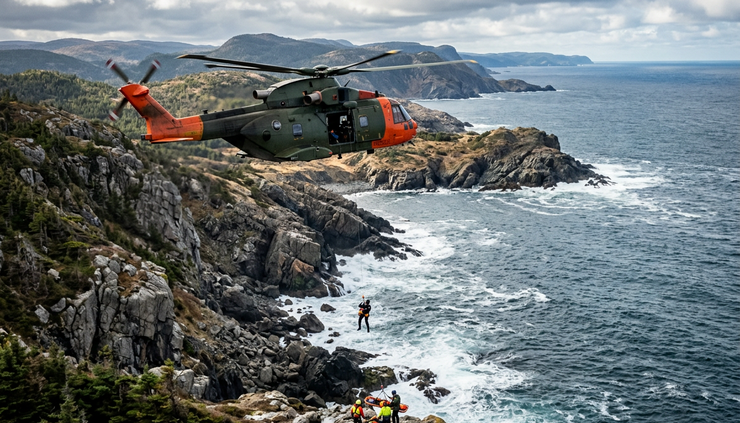
Search and rescue remains one of the RCAF’s most visible day-to-day missions. Canada’s size and climate make SAR a demanding task. Crews fly over mountains, oceans, forests, Arctic ice, and remote lakes. Aircraft such as the CC-130 Hercules, CH-149 Cormorant, CH-146 Griffon, and other SAR platforms have saved lives in conditions that test both machines and crews.
Modern operations connect Canada to global security
Since the 1990s, the RCAF has taken part in operations far beyond Canada’s borders. The post-Cold War era brought missions in the Gulf region, the Balkans, Afghanistan, Libya, Iraq, Eastern Europe, and the Arctic.
The CF-18 Hornet became the RCAF’s main fighter in the 1980s and has remained a central aircraft for decades. It has served in NORAD defence, NATO air policing, combat missions, and coalition operations. Canadian CF-18s took part in the 1991 Gulf War and later flew missions over the Balkans, Libya, and the Middle East.
Airlift has grown just as important. The CC-177 Globemaster III gave Canada the ability to move large cargo quickly over long distances. The CC-130J Hercules supports tactical transport, including rougher airfields and shorter routes closer to operations. The CC-150 Polaris has provided transport and air-to-air refuelling, though Canada is moving toward newer tanker and transport aircraft under current modernization plans.
Maritime patrol aircraft remain essential for a country with three ocean approaches. The CP-140 Aurora has flown long-range patrols, anti-submarine missions, surveillance, and support to domestic and international operations. It reflects a wider shift in air power, where sensors, data, and endurance can matter as much as speed.
Helicopters have also evolved. The CH-124 Sea King served for more than five decades at sea, operating from Royal Canadian Navy ships in demanding conditions. The CH-148 Cyclone now fills the maritime helicopter role. The CH-147F Chinook provides heavy-lift capability, while the CH-146 Griffon supports tactical aviation, domestic response, and training.
Technology changes what air power can do
The RCAF has moved from fabric-covered biplanes to integrated digital systems in a century. Key advances include:
Era | Major shift | What it changed |
1920s and 1930s | Aerial photography and bush flying | Helped map and connect remote Canada |
Second World War | Radar, radio navigation, mass training | Made large-scale air campaigns possible |
Cold War | Jet aircraft and early warning networks | Put speed and continental defence at the centre |
Late 20th century | Precision weapons and modern sensors | Improved accuracy and mission planning |
21st century | Data links, satellite support, remotely piloted systems | Connected aircraft, crews, and commanders faster |
Modern air operations depend on information. A fighter, patrol aircraft, or helicopter now acts as part of a network. It gathers data, shares it, and reacts with other aircraft, ships, ground forces, and allied commands.
Canada’s planned acquisition of the F-35A will mark another major step. The aircraft is designed around stealth, sensors, and networked operations. It will replace the CF-18 and shape RCAF fighter aviation for decades.
The RCAF is also preparing for remotely piloted aircraft systems, renewed surveillance needs in the Arctic, and the growing importance of space-based support. These tools will not replace pilots and crews, but they will change how Canada watches its approaches and contributes to allied missions.
Notable aircraft that shaped the RCAF
Some aircraft stand out because they carried the RCAF through turning points.
Vickers Vedette
A flying boat used in the interwar years, the Vedette helped Canada survey forests, lakes, and coastlines. It suited a country where water often served as the best runway.
North American Harvard
The Harvard became one of the great training aircraft of the Second World War. Thousands of pilots learned advanced flying skills in aircraft like it before moving to fighters or bombers.
Avro Lancaster
The Lancaster remains closely linked to Canadian bomber squadrons in Europe. Its range and payload made it one of the key heavy bombers of the war.
Canadair Sabre
Fast, agile, and respected, the Sabre defined the early jet era for Canada and served with NATO forces in Europe.
Avro Canada CF-100 Canuck
The CF-100 was a Canadian-designed all-weather interceptor. It gave the RCAF a homegrown Cold War defence aircraft.
CF-18 Hornet
The CF-18 has carried Canada’s fighter mission for more than 40 years, from NORAD alert to NATO and coalition operations.
CC-177 Globemaster III
This aircraft changed Canadian strategic mobility. It lets Canada move heavy equipment, helicopters, vehicles, and relief supplies over intercontinental distances.
CH-149 Cormorant
Built for long-range search and rescue, the Cormorant gives Canadian crews the reach and lifting power needed for difficult rescues.

A century of service and an air force still changing
The Royal Canadian Air Force began in 1924 with practical national tasks: chart the land, patrol the coasts, and make aviation useful across a vast country. The Second World War transformed it into a major combat and training force. The Cold War pushed it into jets, radar, NORAD, and NATO. Peacekeeping and humanitarian missions showed how air power could protect lives as well as territory. Modern operations now demand aircraft that can sense, share, move, strike, rescue, and endure.
The RCAF’s history is full of famous machines, but its deeper story is about adaptation. Each generation faced a different sky: open-cockpit flying, night bombing, jet interception, maritime patrol, peacekeeping airlift, Arctic surveillance, and digital warfare. The aircraft changed, the technology changed, and the missions widened.
What has not changed is the central challenge Canada has always faced. The country is vast, the weather is unforgiving, and the world beyond its borders still matters. For a century, the RCAF has met that challenge from the air. Its next chapter will be written with new fighters, new sensors, new training systems, and the same demanding geography that shaped it from the start.


Comments